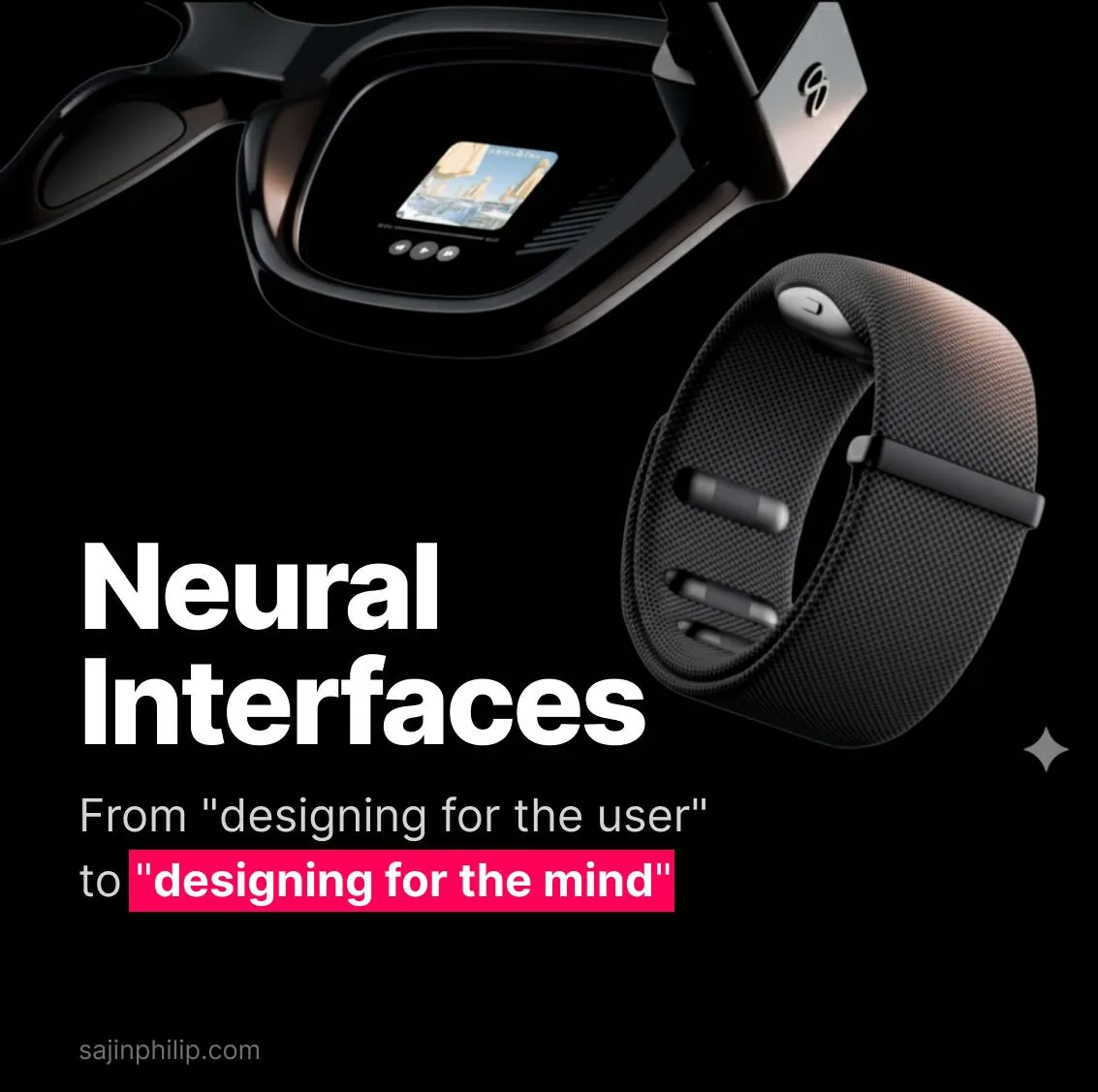
Meta is working on EMG (electromyography) wristbands that detect the tiny electrical signals your brain sends to muscles in your wrist and fingers.
A simple wristband picks up the tiny electrical signals your brain sends to your fingers. Even the intention to move (like thinking of a click) can be translated into a digital command.
The shift to neural interfaces is a paradigm-altering moment that redefines the very nature of human-computer interaction. Beyond simply designing for new modalities like gestures, it requires shifting from screen-based thinking to creating experiences that are invisible, intuitive, and deeply personalized.
Here's a breakdown of the evolving user interaction landscape driven by neural interfaces and how you can prepare.
From explicit commands to inferred intent: Instead of relying on explicit actions like clicks or voice commands, systems will anticipate user needs by decoding their neural or neuromotor signals. This means an app could simplify its interface when it detects mental fatigue or adjust content based on a user's emotional state.
From conscious effort to subtle gestures: Meta's neural band uses sEMG to read faint muscle signals, enabling private, subconscious control. Instead of performing a large, visible motion, a user can simply tap their fingers together to select an item, reducing cognitive load and making interaction seamless.
From "designing for the user" to "designing for the mind": This new field, sometimes called Neuro-UI, requires designers to consider cognitive science principles like perception, attention, and memory. The goal is to build interfaces that feel natural and effortless by aligning with how the brain processes information.
From 2D to immersive 3D interfaces: Neural interfaces will be paired with AR and VR to create multi-sensory and three-dimensional experiences. UI elements will be integrated into the physical world, requiring designers to consider spatial awareness, user comfort, and instinctive interactions.